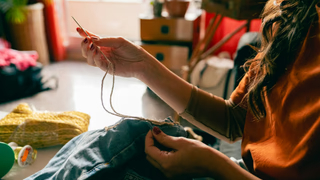
60% of high-end fashion now embraces sustainability in 2026 , but talk to the designers behind that number and the story shifts. Many will tell you the road to circularity felt less like triumph and more like a series of collisions: between aspiration and budget, between creative instinct and algorithmic output, between the garment they envisioned and the one the planet could sustain.
The circular fashion resale market surged from $181.4 billion in 2024 to nearly $203 billion in 2025 [OpenPR], proving consumer appetite is real. Yet the designers serving that appetite have undergone a quieter, messier shift. It was driven not by market demand alone, but by AI tools that forced them to rethink every silhouette, every texture, every material choice from the ground up. This is the story of two parallel worlds converging into something genuinely new.
The Dream That Almost Broke Them
In one world, independent designers entered circular fashion with fierce idealism.
 Photo by
 They wanted garments with curated end-of-life journeys: pieces designed for disassembly, crafted from deadstock or bio-fabrics, built to outlive trends. The vision was effortless elegance meeting ecological responsibility.
In the parallel world, the numbers told a harsher story. Sourcing certified recycled materials at scale proved nearly impossible for small studios. Minimum order quantities for bio-fabrics dwarfed what emerging labels could afford. The textile recycling market was valued at $6.34 billion in 2025 and projected to reach $9.94 billion by 2033 [Globenewswire]. It was growing, but infrastructure lagged behind designer ambition.
Where these worlds intersected was painful. Designers who cared most about circularity often burned through resources fastest. The dream was real but brutally under-resourced. That is precisely when AI arrived, promising rescue.
AI Enters But Complicates Everything
The first wave of AI tools looked like liberation.
 Photo by
 Generative design platforms, virtual sampling software, and material lifecycle trackers flooded studios. Adidas integrated AI into design and virtual sampling, reducing physical prototypes by 65% and speeding up development by 50% [Nul Global]. Brands adopting AI for apparel visualization cut sampling costs by 50% or more through digital twins.
For circular-focused designers, though, a tension emerged. Most AI tools had been trained on conventional, linear fashion datasets, optimized for speed and cost rather than proportion-conscious disassembly or regenerative material flows. Designers found themselves manually reworking AI outputs to meet circularity standards, adding labor rather than reducing it.
The complication ran deeper than workflow. Many designers wrestled with authorship anxiety: the fear that AI collaboration would flatten their creative voice into something generic. The tool meant to simplify the journey had introduced new layers of creative disorientation.
Still, something unexpected was hiding beneath the frustration.
The Unexpected Turning Point
The designers who thrived stopped treating AI as an answer machine and started treating it as a co-investigator.
 Photo by
 Instead of asking AI to generate solutions, they fed it their failures: rejected material tests, returned garments, supply chain dead ends. Those loops refined future designs in ways no brief could.
Printful’s AI optimizes design placement on materials, reducing fabric waste in on-demand manufacturing [Texintel], offering a glimpse of this philosophy at scale. Tommy Hilfiger uses AI to analyze trend data and suggest design elements, allowing virtual experimentation before cutting a single piece of fabric [Nul Global].
Three key capabilities emerged from this pivot:
-
Lifecycle simulation: modeling a garment’s full journey from fiber to disassembly before any physical sampling
-
Failure-fed iteration: treating rejection data as the most valuable design input
-
Pattern optimization: AI predicting cycles and arranging cuts for minimal waste
The turning point was not a new tool. It was a new relationship with data, failure, and the full lifecycle of a garment.
Circular Triumph Looks Different Now
By 2026, circular triumph is not defined by perfect sustainability metrics.
 Photo by
 It is defined by adaptive, AI-informed systems that evolve with every collection and remain accessible across budget tiers.
“Regenerative agriculture aims to restore soil health, increase biodiversity, and improve water cycles while producing fiber.”
That vision of regeneration now extends beyond agriculture into the design studio itself. The most celebrated circular designers share their process openly, building community trust through transparency rather than guarding proprietary methods.
What matters is that this evolution celebrates personal style over conformity. AI does not dictate a single circular silhouette. It offers options. A designer working with a $500 material budget and one working with $50,000 can both access simulation tools, optimize for longevity, and design garments meant to outlive their first owner.
The unified insight from these converging worlds: circularity is not a destination. It is a continuously evolving, AI-informed creative practice. The most sustainable thing a designer creates is not a garment but a system built to learn.
AI did not hand fashion designers an easy path to circularity. It made the path more honest. The designers thriving in 2026 embraced data fluency, lifecycle thinking, and collaborative humility over perfectionism. Whether your next collection has a budget of hundreds or hundreds of thousands, simulation tools are more accessible than ever. Starting with simulation before stitching, and letting every failed prototype fuel the next iteration, is worth considering. The curated wardrobe of the future begins with a design process willing to evolve.
🔖
- Globenewswire: Textile Recycling Market to Hit USD 9.94 Billion by 2033
- Nul Global: AI in Sustainable Fashion Use Cases and Technology
- OpenPR: Circular Fashion Resale Market Set for Significant Growth
- Texintel: Printful Shows How On-Demand Manufacturing Reduces Textile Waste
- Inside Fashion Design: Regenerative Design in Fashion, Textile Exchange quote