Riiven Wild
How Forest Elephants Help Trees Store More Carbon
Forest elephants in the Congo Basin eat and trample their way through the understory, and the trees left standing hold more carbon than the ones they never touched.
The Scene
A trail cuts through the understory of a Gabonese forest, packed hard and about a meter wide, threading between buttressed trunks toward a stream. It was made by forest elephants walking the same route for decades. Along its edges the saplings are snapped or stripped, bark peeled in long strips, leaves pulled from thin stems within reach of a trunk. Overhead the canopy is intact. The animals themselves are rarely visible; researchers counting them across large spatial scales have had to rely on dung surveys and indirect signs rather than sightings, as work on density estimation methodologies for African forest elephant has documented. The trail and the browsed edges outlast the animals that made them.
The Creature
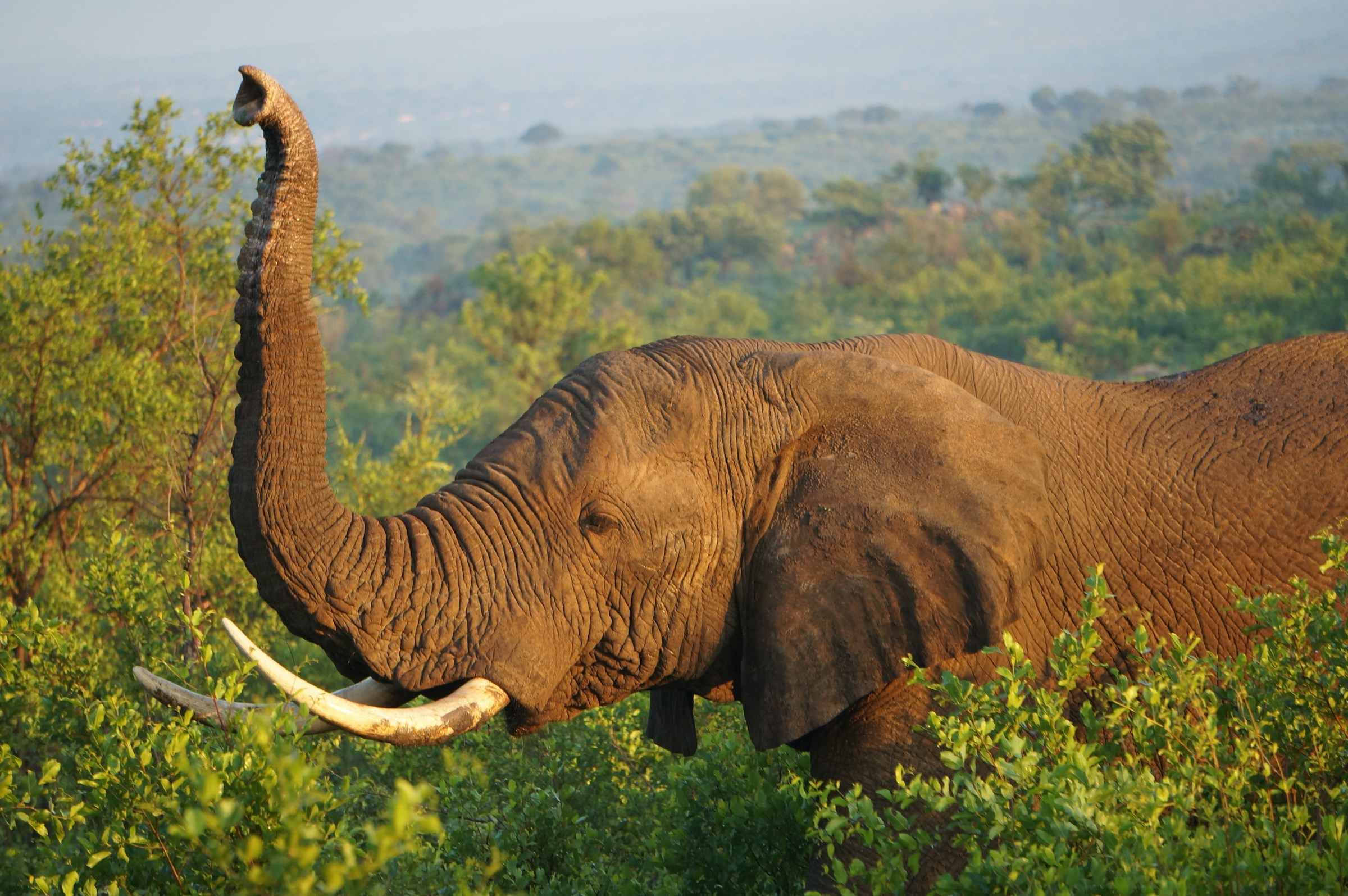
The African forest elephant is smaller than its savanna relative, with straighter tusks and rounded ears, built for moving through dense vegetation rather than open grassland. It spends much of the day feeding, taking fruit, leaves, bark and whole young stems. It works through a patch rather than stripping it evenly, breaking some plants and walking past others. Densities across central Africa are low by the standards of large herbivores, on the order of 0.5 to 1 elephant per square kilometer in the forests where researchers have measured the effect on carbon. Elephants also carry seeds. Fruit passes through the gut and is deposited, often kilometers from the parent tree, which makes the animal a long distance disperser for a large set of tree species.
How It Works
The mechanism is thinning by appetite. A 2019 study led by Berzaghi and colleagues, published in Nature Geoscience and covered by Eos, modeled what elephant browsing does to forest structure: browsing reduces the abundance of smaller, lower wood density trees and favors fewer, larger trees with higher wood density, which raises aboveground carbon storage. Field measurements from Congo Basin forests found that elephant disturbance increased modeled aboveground biomass by 26 to 60 metric tons of carbon per hectare at the typical densities of 0.5 to 1 elephant per square kilometer. Running the model the other way, removing forest elephants from central African forests would reduce vegetation carbon storage by 7 percent, close to 3 billion metric tons of carbon. A later analysis of 260 one hectare botanical plots across Gabon put a measured figure alongside the model: stands with elephant activity stored an average of 8.5 megagrams of aboveground carbon per hectare more than stands without, a 6.4 percent increase.
Watch
The Ripple
The effect does not stop at the trees the elephants eat. Removing crowded low density saplings frees light, water and soil nutrients for the stems that remain, so the survivors grow thicker and taller. Slow growing hardwood species, the ones with dense timber and heavy fruit, gain the most. A 2024 PNAS study describes both halves of the process working together: selective browsing that removes less carbon dense plants, and seed dispersal that moves the seeds of carbon dense species out into new ground. The trees that benefit are often the same ones that feed hornbills, primates and duikers with large fleshy fruit, so the dispersal loop feeds back on itself. The 2024 work on forest elephant activity and forest carbon stocks found the association holds where elephants are still present. Where they have been hunted out, the understory fills in with fast growing, light wooded stems, and the structure of the forest drifts toward something that stores less.
Why It Matters
Central African forests are counted as one of the world's large carbon reservoirs, and part of that reservoir is maintained by an animal that is hard to census and easy to lose. The 7 percent figure from the 2019 Nature Geoscience study is not a projection about future forests. It describes carbon already held in trees whose shape and density reflect decades of elephants walking through and feeding.
Sources
- Assessing the feasibility of density estimation methodologies for African forest elephant at large spatial scales · study
- Bergazhi et al., Carbon stocks in central African forests enhanced by elephant disturbance, 2019 (2019) · context
- Elephants Boost Carbon Storage in Rain Forests - Eos.org (2019) · context
- Forest Elephant Activity Associated with High Forest Carbon Stocks, 2024 (2024) · context
- Biogéosciences, Article published in PNAS, 2024 (2024) · context


