Riiven Sparks
Saccharin
A chemist forgot to wash his hands before lunch, and the sweetness he tasted sent him back to the lab to lick every piece of equipment he had touched.
In 1879, Constantin Fahlberg sat down to eat and noticed his bread tasted impossibly sweet. He was a chemist working in Ira Remsen's lab at Johns Hopkins, studying coal tar derivatives. Coal tar is the black sludge left over from making gas from coal. Nothing about it should taste like dessert. Fahlberg put down the bread. He thought about what he had touched that day.
The pivot
Intent
Study coal tar derivatives
Outcome
The first mass-market artificial sweetener
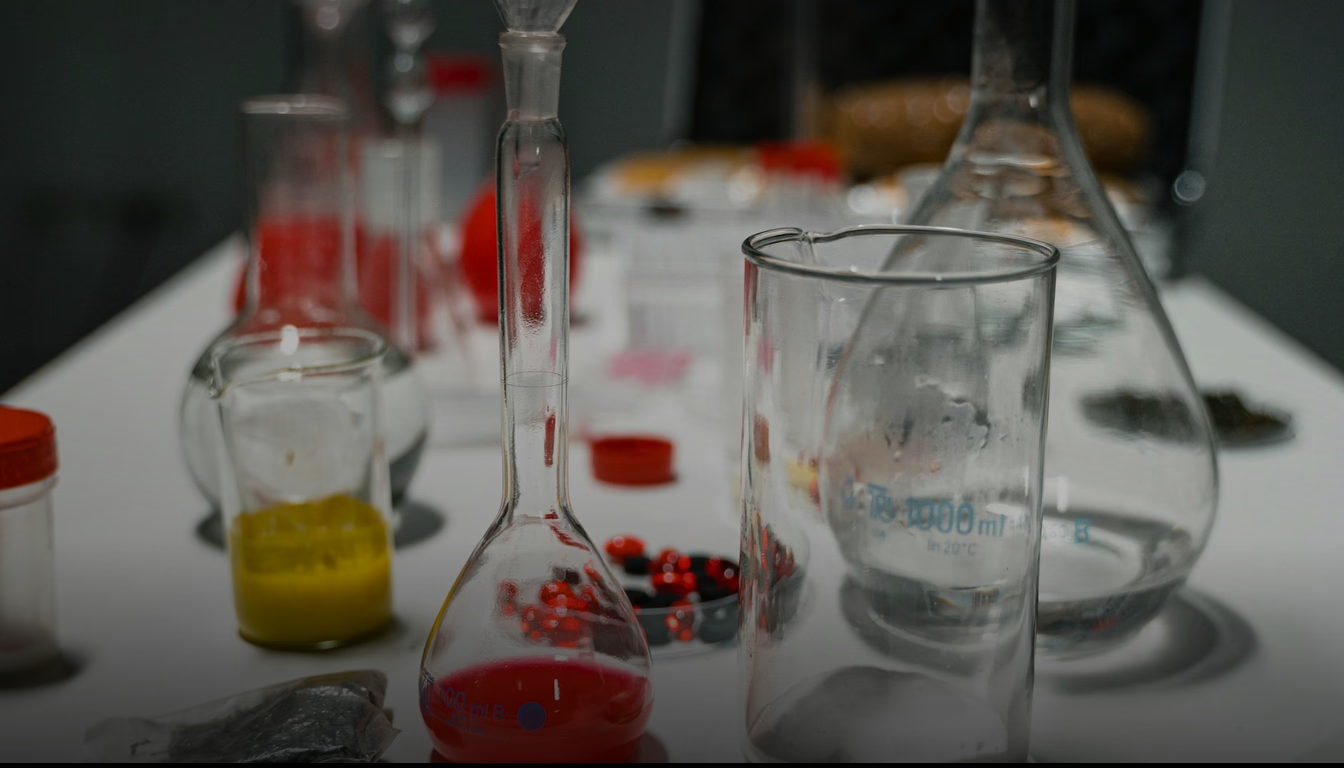
Remsen's Baltimore lab was deep in the chemistry of coal tar, the thick residue from coal gas plants that nineteenth-century chemists were taking apart molecule by molecule. The work was unglamorous. Coal tar smelled awful and stained everything it touched. But it was also a goldmine of new compounds, and dyes pulled from it had already built fortunes in Germany. Fahlberg had come from there to work with Remsen on oxidation reactions of toluene sulfonamides. The goal was academic. Understand the chemistry. Publish the paper. Nobody was looking for a sweetener. Nobody was looking for anything you would put in your mouth at all.
That evening in 1879, Fahlberg forgot to wash his hands before dinner. He picked up a roll and the sweetness hit him. It was stronger than sugar, by a wide margin, and it lingered. A normal person would have rinsed off and moved on. Fahlberg went back to the lab. He started tasting things. He licked his beakers, his dishes, the rim of one flask after another, trying to find which reaction had produced the sweet compound. This was reckless even by 1879 standards. Coal tar work involved plenty of substances that could kill you. He kept going until he found it: a residue in one specific beaker where he had let a mixture boil over.
The compound was benzoic sulfimide. Fahlberg and Remsen published it together in 1880. Then Fahlberg quietly filed patents in his own name, set up a factory in Germany, and started selling the stuff as saccharin. Remsen was furious and never spoke to him again. Sales were slow at first; sugar was cheap and saccharin tasted faintly metallic. Then sugar shortages during World War One pushed it into kitchens. Diabetics adopted it. Diet culture found it in the 1950s and never let go. By the time the FDA tried to ban it in 1977 over rat studies, American consumers wrote so many angry letters that Congress overrode the ban.
A burned pot of coal tar byproducts became the sweetener in pink packets on every diner table.
Watch
The angle
What did you almost wipe off today without stopping to ask why it was there?