Riiven Slants
First Sleep, Second Sleep
We are built to wake up at 2 AM. The light bulb taught us to call it insomnia.
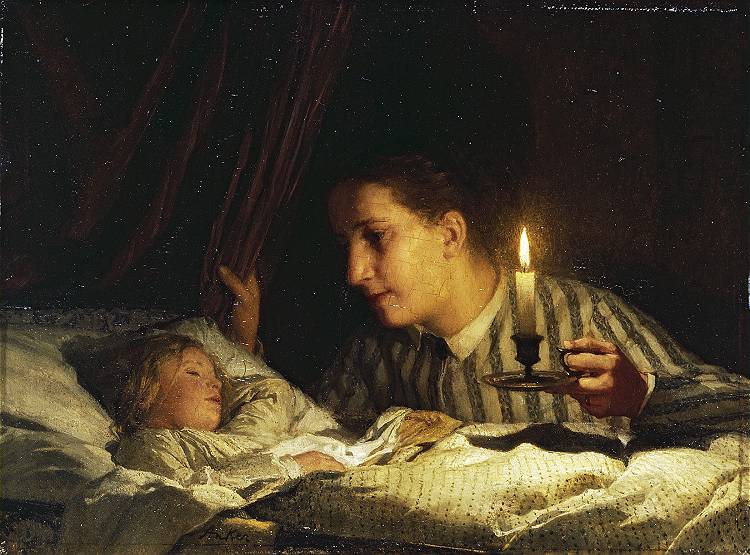
Every doctor recommends eight hours of unbroken sleep. The diaries kept before the light bulb describe something else. The continuous sleep block is younger than electric light, and it is already in trouble.
For most of European history, people slept in two shifts. Bed around nine, wake around midnight, stay up an hour or two, then sleep again until dawn. The historian Roger Ekirch counted eighty-three references to 'first sleep' across seventy-two sources written between 1300 and 1800. None of them stop to explain the term.
The hour between sleeps had its own etiquette. People prayed, had sex, visited the neighbors, wrote down dreams. Court records mention crimes committed in it. Medical manuals from the 1500s gave specific advice on how to spend the second waking.
Then artificial light arrived. Gas lamps in the 1820s lengthened the evening. Electric bulbs in the 1880s erased nighttime altogether. The midnight wake-up shifted toward 2 AM, then vanished into one continuous block. By 1920, the words 'first sleep' and 'second sleep' had dropped out of normal English.
The modern person who wakes at 2 AM and cannot fall back asleep is not malfunctioning. Their nervous system is doing what nervous systems did for most of recorded history. The difference is that now they reach for a phone, check the time, google 'insomnia,' and start to panic. Their great-grandfather would have lit a candle and read until tired again.
In 1992 a psychiatrist named Thomas Wehr ran an experiment. He kept volunteers in dark rooms for fourteen hours a day, with no clocks and no electric light. Within a month, almost every subject reverted to two-shift sleep. The body remembers what the calendar forgot.
The tilt
Insomnia is a billion-dollar industry built on a habit younger than the light bulb. The 2 AM wake-up was a feature until someone invented better evenings.
Sources
- A. Roger Ekirch, At Day's Close: Night in Times Past (W. W. Norton) (2005)
- A. Roger Ekirch, Sleep We Have Lost: Pre-industrial Slumber in the British Isles (American Historical Review, 106:2) (2001)
- Thomas A. Wehr, In Short Photoperiods, Human Sleep is Biphasic (Journal of Sleep Research, 1:2) (1992)
- 'Have we lost sleep? A reconsideration of segmented sleep in early modern England' (Medical History, Cambridge University Press). Challenges the Ekirch thesis. (2023)


