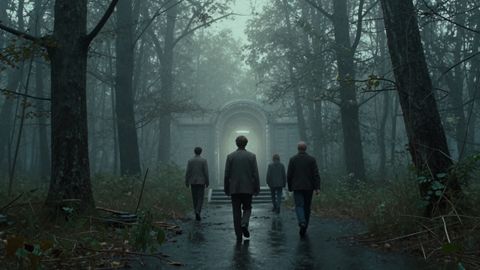
She steals a grape.
That is all. One grape, lifted from a banquet table in a chamber so silent you can hear your own pulse. The Pale Man sits at the far end, motionless, his skin draped over his bones like a sheet over furniture no one uses anymore. His face is a ruin: no eyes, only the suggestions of where eyes once were, and in his palms, two small holes through which he will soon see perfectly well. The food on the table is almost unbearable in its abundance - roasted meat, stacked fruit, candles burning with the patience of something that has waited centuries. A placard warns her. The faun warned her. Every instinct in the architecture of the room warns her.
Ofelia reaches anyway.
She is eleven years old. She lives in a house ruled by a man who uses silence as a weapon and clocks as a religion. She has been told, in every language available to adults, that she is invisible, that her imagination is an embarrassment, that the only story that matters is the one unfolding at the dinner table she is not permitted to fully inhabit. And here, in this terrible underground room, she sees something she wants. So she takes it.
The Pale Man’s head tilts. His hands rise slowly to his face. He presses his palms to his eyeless sockets and the darkness inside him finds its direction.
What follows is pure, screaming consequence. But Ofelia runs.
We spend so much of our lives not reaching. We calculate the cost before we extend our hand, and usually the calculation is correct - the grape is not worth the Pale Man. Caution is a reasonable survival strategy. But something in us knows that caution, practiced long enough, becomes its own kind of disappearance. The person who never reaches becomes very still, very quiet, and eventually the stillness is mistaken for contentment.
Ofelia reaches for the grape not because she is reckless. She reaches because she has been made so small, for so long, that the act of wanting something openly feels like the only true thing left to her. The underground kingdom is dangerous, yes - del Toro never lets us forget that - but it is the one place where her desires have weight, where what she chooses bends the world around her.
The stories we tell ourselves in the dark are not lies; they are blueprints for the people we are trying to become.Most of us will never face a Pale Man or a captain’s pistol. But we know the feeling of a room that forbids wanting. We know the calculus of swallowing desire to keep the peace. And sometimes, in some small chamber of our own lives, we reach for the grape anyway - not wisely, not safely, but honestly.
And then we run.