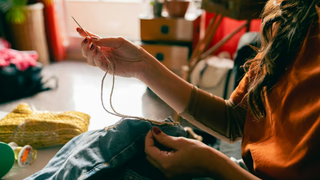
A jacket tears on Monday. By Friday, it’s nearly whole again, no needle or tailor required. That’s not science fiction. Lab tests on self-healing fabrics now show tensile strength recovery rates approaching 80%, and the fashion industry is starting to pay attention.
The timing matters. EU Digital Product Passport rules tighten through 2026, and circular fashion demand keeps rising against sluggish industry growth. Brands face real pressure to prove garment longevity, not just claim it. Self-healing fabrics offer a measurable answer, turning durability from a marketing word into a testable performance metric.
Perspective A: The Materials Science Optimist
To materials scientists, self-healing textiles represent a quiet win for cross-industry engineering.
 Photo by
 The core chemistry involves polymers, long-chain molecules that reknit themselves after damage, originally developed for aerospace composites and biomedical implants before reaching the loom.
Recent research reflects that maturity. A 2026 PTWPU membrane study, where PTWPU refers to a polyurethane-based self-healing polymer, reported roughly 80% recovery of tensile strength after heating at 120°C for two hours [SSRN Papers]. A separate CAN film, a covalent adaptable network material that reforms broken chemical bonds, showed an average strength recovery ratio of 86% across repeated tests [Advanced]. One system reached 82.4% healing efficiency in air after seven days and nearly 100% underwater after ten [ACS Applied].
For optimists, the case is clear:
-
Fibers heal from within, rather than relying on surface coatings that wash away
-
Recovery happens under mild conditions: heat, moisture, or simply time
-
The same science used in medical dressings can translate into everyday outerwear
Fashion is inheriting decades of R&D and skipping ahead on the innovation curve.
Perspective B: The Fashion Industry Skeptic
 Photo by
 Inside fashion, the mood is more measured. A textile that heals in a lab at 120°C isn’t the same as a blazer that heals in a closet. Skeptics are quick to note the gap between lab data and lived wardrobes.
Three concerns dominate industry conversations:
- Cost. Self-healing polymers remain expensive to produce, pushing finished garments into premium and technical tiers rather than mainstream racks.
- Aesthetics. Current healing chemistries favor synthetic blends, which limits the textures, silhouettes, and natural-fiber proportions many designers prefer.
- Sustainability optics. A synthetic-heavy fabric that repairs itself still sits awkwardly next to the industry’s circular and bio-based messaging.
“Multifunctional materials are needed to meet complex real-world requirements in smart textiles, medical textiles, and outdoor apparel.” [SSRN Papers]
Skeptics don’t dispute the science. They question whether fashion’s fast cycles, tight margins, and diverse budgets can absorb it at scale.
Synthesis: Where the Two Views Meet
Held side by side, the optimist and skeptic views are less opposed than they appear.
 Photo by
 Lab data confirms recovery rates above 80% within two hours, with efficiencies sustained above 60% across repeated cycles in tested membranes [SSRN Papers]. The commercial hesitancy is equally real.
What emerges is a clearer picture of where self-healing textiles fit right now:
-
Technical and performance wear such as outerwear, workwear, and activewear, where durability premiums are already accepted
-
Luxury investment pieces, where cost-per-wear logic rewards long-lived materials
-
Regulated categories under EU Digital Product Passport scrutiny, where documented longevity becomes a compliance asset, not just a story
This isn’t a revolution arriving all at once. It’s a layered rollout, shaped as much by budget and aesthetics as by chemistry.
Self-healing textiles aren’t a rule about how clothes should be. They’re an option expanding what clothes can do. Verified recovery rates reach 80% and above in controlled settings, borrowed from aerospace and medicine. Fashion adoption will be slower, shaped by price, personal style, and sustainability priorities that vary from closet to closet.
Still, the direction is worth watching. As 2026 regulations and circular-fashion demand converge, effortless longevity may quietly become one of the more meaningful luxuries a wardrobe can offer.