The amygdala doesn’t care about your design aesthetic. When it detects sharp angles in a room, a knife-edge console or a rigid rectangular frame, it fires a low-grade threat response: the same ancient alarm that once flagged thorns and predator teeth. Curved shapes, by contrast, activate reward circuits linked to safety and approachability. That biological reality has simmered beneath decades of angular minimalism, and neuroscience has long suggested what residential design is now beginning to reflect. Curves are dominating home interiors, driven by a post-minimalism hunger for warmer, more intentional living spaces. This isn’t a fleeting Pinterest mood. It’s design finally catching up to the brain.
When Sharp Corners Felt Wrong
Long before brain imaging existed, people sensed something off about sharp-edged rooms.
 Photo by
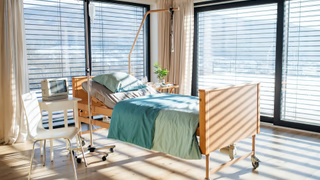
 Mid-century modernism’s rigid geometry thrived in institutions: hospitals, factories, government offices. These were spaces built for efficiency and control, not emotional comfort. Homes with arched doorways, soft moldings, and rounded alcoves were always described differently: warmer, more welcoming, easier to breathe in.
That gut reaction wasn’t arbitrary. Studies using virtual room simulations show participants consistently rate angular spaces as more threatening and less inviting than curved equivalents, even when furniture, color, and lighting stay identical. The pattern holds across cultures, pointing to something biological rather than learned.
Children reveal the preference most clearly. Without instruction, toddlers gravitate toward rounded toys and furniture, avoiding sharp-edged objects instinctively. Pediatric design guidelines have long recommended curved furniture to reduce both physical injury and psychological stress. Our discomfort with hard edges starts early and runs deep.
Brains Built for Soft Shapes
The amygdala, the brain’s threat-detection hub, shows measurably higher activation when viewing angular shapes compared to rounded ones. Curved lines, by contrast, light up regions linked to reward and approachability.
 Photo by
 This isn’t a subtle preference. It’s a fundamental feature of human perception.
Evolutionary psychologists trace the response to survival logic:
-
Sharp shapes in nature signaled danger: thorns, claws, cliff edges, bared teeth
-
Curved shapes signaled safety and abundance: rolling hills, flowing water, the contour of a living body
Even brief exposure to curved architecture appears to lower cortisol levels. Environmental psychology research links softer spatial design to reduced heart rate and improved mood within minutes. The shapes surrounding us don’t just influence taste. They chemically shift how safe we feel.
Curves Crossing Every Design Industry
 Photo by
 The cultural pivot is now unmistakable. Curved sofas, arched shelving, and oval dining tables have surged in demand since 2020, with the global furniture market reflecting growing consumer appetite for organic, rounded forms [Openpr].
“We’re in a moment where people crave comfort, tactility, and emotional warmth in their homes.” [Openpr]
The shift extends beyond furniture. Architects like the late Zaha Hadid pioneered fluid, curvilinear structures that feel organic rather than imposed. That philosophy is now filtering into mainstream residential projects. Curved facades, arched doorways, and rounded room transitions are appearing in new developments at a pace that would have seemed impractical a decade ago.
Consumer electronics tell a parallel story. Apple’s evolution from boxy early Macs to seamlessly rounded devices mirrors the broader movement. Designers now describe curved silhouettes as “human and approachable” rather than merely stylish [Openpr]. U.S. furniture trends in 2024 emphasized sustainability, comfort, and individuality with organic luxury [Fortune], and curves sit squarely at that intersection.
Bringing Softness Into Your Home
 Photo by
 A full renovation isn’t necessary. Small, intentional swaps can meaningfully shift a room’s emotional temperature.
-
One curved anchor piece, such as a round coffee table or an arched mirror, softens a space more effectively than repainting walls
-
Circular rugs break harsh rectangular room geometry and remain one of the most affordable curve-forward changes
-
Rounded throw pillows and draped fabrics add organic softness without any structural commitment
-
Houseplants with flowing, rounded leaves carry the same neurological calming effect as designed curves
“Curves instinctively feel comforting. They’re inherently more inviting.”
It helps to notice what already feels rigid. A sharp-cornered console table, a strictly geometric light fixture, a hard-edged shelf: each represents an opportunity. One substitution won’t transform a home overnight, but it shifts the ratio. And the brain, scanning constantly for threat or safety, registers the difference before you consciously do.
Our brains evolved reading curves as safe and sharp edges as threatening. That survival instinct never switched off. Design is finally honoring that wiring, moving from angular minimalism toward something warmer and more balanced. The encouraging part is how little it takes. One round table, one arched mirror, one trailing plant with soft leaves. These aren’t just decorating choices. They’re quiet negotiations with a nervous system still scanning for ancient dangers. The most calming room you’ll ever shape may simply be one your brain already recognizes as home.