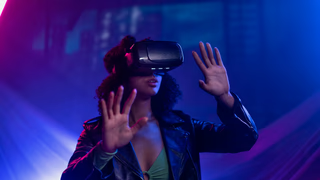
Picture this: a professional gamer steps away from their desk, straps on a VR headset, and starts throwing punches at virtual opponents. Thirty minutes later, they’re drenched in sweat, having burned nearly 300 calories while sharpening their competitive reflexes. Meanwhile, across town, athletes on a basketball court dodge augmented reality obstacles projected onto the floor.
This isn’t science fiction. It’s the emerging world of hybrid sports. These new competitions merge esports precision with physical athleticism, creating a landscape that challenges what we thought we knew about both gaming and traditional sports. Whether you’re a gamer seeking more movement or an athlete curious about digital integration, hybrid sports offer something genuinely new.
When Gaming Meets Physical Competition
Hybrid sports work by connecting your body to the game.

Players use motion sensors, VR headsets, or smart equipment to control digital elements through physical movements. Every dodge, swing, and step gets tracked in real-time, influencing game outcomes based on your speed, accuracy, and positioning.
This fusion creates entirely new skill requirements. Unlike traditional esports where you sit for hours perfecting mouse movements, hybrid competitors must maintain cardiovascular fitness and physical coordination while executing strategic gameplay. Think of it like playing chess while running. Competitions measure both physical endurance and tactical decision-making under pressure, rewarding athletes who can think and move simultaneously.
Popular Hybrid Sports Emerging Today
Several hybrid sports have already established competitive leagues with real prize money.
 Photo by
 Hado stands out as a prime example. Players wear AR headsets and throw virtual energy balls at opponents in physical arenas, combining dodgeball’s intensity with digital gameplay. International tournaments now span over 30 countries with organized league structures.
Drone racing takes a different approach. Pilots navigate physical courses at speeds exceeding 90 mph while viewing everything through first-person-view goggles. It merges piloting skills with spatial awareness in ways traditional racing never could. Professional leagues now offer six-figure prize pools and ESPN broadcasting coverage, signaling serious mainstream acceptance. Even major esports events are going hybrid. The League of Legends World Finals featured AR dragons swooping over the stadium while fans used apps for AR scavenger hunts.
Health Benefits and Performance Data
The fitness benefits are measurable and impressive.
 Photo by
 VR boxing on platforms like Meta Quest 3 burns 6-8 calories per minute. Games like Beat Saber at expert levels burn around 241 calories per 30-minute session. That’s comparable to moderate-intensity traditional exercise, but with the engagement that keeps people coming back.
Beyond calories, players develop strategic thinking and spatial reasoning while maintaining active movement. As one VR athlete put it: “I didn’t ‘get fit’ in VR. I learned how my body moves under sustained stress. That changed everything else”. This dual engagement addresses health risks associated with sedentary gaming while building skills that transfer to other athletic pursuits.
The Future of Competitive Play
Technology keeps pushing these sports forward.
 Photo by
 5G networks and improved AR/VR hardware enable more sophisticated gameplay with lower latency and better immersion. As equipment costs decrease, accessibility improves for amateur players who want to compete without professional-level investment.
Institutional recognition is following this technological progress. Olympic committees are evaluating hybrid sports for inclusion, recognizing their appeal to younger demographics and athletic legitimacy. Pilot programs at youth sports facilities show significantly higher engagement than traditional options. By 2026, esports events are expected to be inherently hybrid, with packed on-site fans plus massive concurrent online audiences. The infrastructure is building, and the audience is ready.
Hybrid sports successfully merge esports strategy with physical athleticism, creating competitions that demand diverse skills from participants. With proven health benefits and growing infrastructure, they represent a genuine evolution in how we think about competitive play.
If you’re curious, many VR gaming centers now offer hybrid sport experiences, and local facilities are increasingly adding these options. The future of competition isn’t about choosing between physical or digital. It’s about mastering both simultaneously.