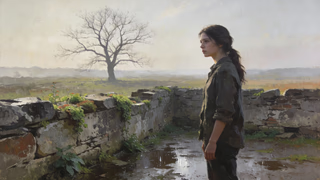
A man climbs down a rope ladder into a dry well in his neighbor’s backyard, pulls the ladder up after himself, and sits in perfect darkness. He is not escaping. He is not hiding. He is waiting for something he cannot name, in a place where time pools like water and the walls press close enough to feel like skin. This is one of the strangest and most quietly devastating images in Haruki Murakami’s 『The Wind-Up Bird Chronicle』, a novel that moves through the world the way dreams move through sleep: with their own unshakeable logic, their own gravity, pulling us down into chambers we didn’t know existed inside us.
Toru Okada has lost his cat. Then he loses his wife. Then he loses something harder to define, something closer to the shape his life used to have. The novel unfolds around these absences like a city built over a sinkhole, each surface stable until you step on it. And through it all, the well. That dark cylinder of stone and silence, waiting.
The Voice From Below
The novel speaks, if we let it, in the register of things we already know but have not yet admitted. It tells us that loss does not always arrive with a crash. Sometimes a person you love simply becomes someone you no longer recognize, and the transformation happens so gradually that you can’t locate the moment it began. Toru’s wife Kumiko doesn’t vanish in a blaze of drama. She recedes. One day she is there, the next she is behind glass, and the glass keeps thickening until her voice reaches him only as a vibration, stripped of meaning.
Murakami sets this private dissolution against the backdrop of historical violence, weaving in stories from the Manchurian frontier of World War II, where soldiers witnessed horrors that broke something permanent in the architecture of their minds. The book asks us to hold both of these together: the intimate unraveling of a marriage and the vast machinery of cruelty that nations construct. It insists they are connected. Not as metaphor, exactly, but as echo. The same darkness runs through both.
And then there is the well. Toru descends into it voluntarily, seeking contact with some deeper layer of reality. In the darkness, with no light at all, he discovers that the boundary between himself and everything else grows thin. He passes through walls. He enters rooms that don’t exist. He touches the face of a woman who might be his wife, or might be someone wearing her face like a mask.
The novel’s voice says: you carry a well inside you. You have always carried it. Most days you walk right over its stone lip without noticing, busy with groceries and emails and the pleasant noise of routine. But it is there, and it is deep, and at the bottom of it sits something that has been waiting for you with the patience of stone.
What We Say Back
 Photo by
 We resist this, of course. We resist it because the well is frightening, and because we have built our lives on surfaces for good reason. Surfaces work. They get us through the day. Think of that moment when you wake at three in the morning and the room is so dark that for a few seconds you cannot remember who you are or where you are or whether you are anyone at all. That flash of formlessness. We pull ourselves out of it as fast as we can, reaching for the phone, the clock, the warm shape of another body beside us. Anything solid.
But Murakami’s novel asks: what if you stayed? Not forever. Not even for long. But what if, instead of scrambling back to the surface, you sat with the darkness for a while and let it speak?
We answer the book with our own losses. The friend who drifted away so slowly that we never had a conversation about it, just a growing silence that calcified into fact. The version of ourselves we were at twenty-two, ambitious and luminous and wrong about almost everything, now unreachable as a country whose borders have been redrawn. The parent whose voice on the phone has started to carry a thinness, a fragility, that we pretend not to hear.
Toru Okada stops moving. He stops applying for jobs, stops maintaining the rhythms of productive adult life, and instead sits in a well. The world would call this depression, or breakdown, or failure. The novel calls it something else. It calls it attention. The deepest kind of attention, the kind that requires the surrender of everything you thought you were.
We say back to the book: we are afraid of that surrender. We are afraid that if we stop performing our competence, our busyness, our cheerful functionality, we will discover that those things were all we had. That underneath the performance there is only the well, only the dark, only the echo of our own breathing against stone.
Where the Silence Answers
 Photo by
 But here is where the dialogue between the novel and our lives becomes something richer than fear. Because Toru, sitting at the bottom of his well, does not disappear. He does not dissolve. Instead, he begins to perceive things that the noise of his former life had drowned out. He feels the presence of other people’s pain, other people’s histories. He touches a mark on his cheek that appeared from nowhere, a bruise or a brand, and it connects him to suffering that extends far beyond his own small story.
The well teaches what the world above cannot: that emptiness is not the opposite of connection but the condition for it.This is not a comfortable realization. Murakami does not offer comfort. The Wind-Up Bird Chronicle is full of violence, manipulation, and the casual destruction of human beings by systems larger than themselves. The character of Noboru Wataya, Kumiko’s brother, embodies a kind of evil that operates through charm and institutional power, hollowing out the people around him while maintaining a polished surface. He is the anti-well: all exterior, all performance, with nothing true underneath.
And yet the novel holds space for something that is not evil and not despair. Toru’s stubborn, almost irrational commitment to finding Kumiko, to sitting in darkness until the darkness yields its secrets, carries a strange dignity. He has no plan. He has no special abilities. He is, by his own admission, an ordinary man. But he keeps descending.
We recognize this. We recognize the moments in our lives when the only honest response to confusion was to stop pretending we understood, to sit with not-knowing until something shifted. The relationship that could not be fixed with conversation, only with presence. The grief that would not be managed or processed or moved through on schedule, that demanded instead a kind of formless waiting. The career that had to be abandoned before a vocation could be found, with no guarantee that anything would emerge from the gap.
Murakami’s genius is in showing us that this waiting is not passive. Toru in the well is the most active character in the novel. He is doing the hardest work a person can do: holding still while reality reorganizes itself around him. The mechanical bird that gives the novel its title winds something unseen, some spring in the fabric of the world, and what Toru does in the darkness is listen for the click of that mechanism, the moment when the spring catches and something begins to turn.
The synthesis, then, is this: the novel speaks of loss and darkness, and we answer with our fear of both. But in the space where those two voices meet, a third voice emerges. It says that the well is not a trap. It is a passage. Not to answers, not to resolution, but to a quality of attention so deep that it becomes a form of love.
The Winding That Never Ends
 Photo by
 We come back from the novel changed in small ways. Not converted, not enlightened. Just slightly more willing to let the silence in. Slightly more aware of the wells hidden beneath the surfaces of our daily lives, the places where meaning pools in darkness and waits for us to descend.
The wind-up bird keeps turning its invisible spring. Somewhere in the distance, just beyond the edge of hearing, a mechanism clicks into place. We don’t know what it sets in motion. We don’t need to know. What matters is that we heard it, that we were quiet enough, still enough, empty enough to catch that small sound against the vast background noise of living.
Toru never fully recovers what he lost, and the novel never pretends he will. But he emerges from the well with something he did not have before: the knowledge that he can survive the dark. That the dark is not his enemy. That what felt like disappearing was actually, all along, the slow and painful work of arriving.
Every surface we walk on is the sealed mouth of a well, and every well leads to the same water.