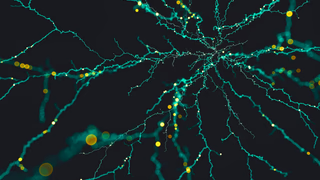
Remember the last time you struggled with a difficult concept? Maybe learning a new language, tackling a math problem, or picking up a musical instrument. That frustration you felt, the mental strain, the mistakes, the urge to give up? That wasn’t failure. It was your brain rewiring itself to become smarter.
Here’s the counterintuitive truth: learning through struggle builds stronger, more durable knowledge than effortless mastery ever could. This insight transforms how we approach challenges, turning moments of difficulty into opportunities for genuine growth. Let’s explore why difficulty triggers powerful neurological changes, what research reveals about struggle’s benefits, and how to harness productive struggle in daily life.
The Struggle Makes You Smarter
When learning feels difficult, something remarkable happens inside your brain.

Rather than simply recording information passively, your mind activates deeper cognitive processes that create stronger, more flexible neural connections.
Think about it this way: effortless learning creates weak memory traces that fade quickly, like writing in sand. Struggle forces what scientists call elaborative encoding. Your brain works harder to make sense of information, connecting it to existing knowledge and creating pathways to retrieve it later.
A 2022 fMRI study of adult learners revealed something fascinating. When participants engaged in high-effort, error-prone learning, activity in the prefrontal cortex and hippocampus increased significantly compared to easier tasks. These brain regions are critical for memory formation and complex thinking.
This happens because of neuroplasticity: your brain’s ability to physically change in response to experience. Not all struggle is created equal, which brings us to understanding exactly how your brain transforms through challenge.
How Your Brain Grows Stronger
The biological process of learning through struggle involves real, measurable physical changes in your brain.
 Photo by
 Each time you struggle and succeed, myelin wraps around the connections you’re building. This fatty substance insulates neural pathways, making signals travel faster and more efficiently. That’s why practiced skills eventually become automatic.
Mistakes play a key role here. When you make an error during learning, your brain’s error-detection circuits light up. These circuits don’t just flag what went wrong. They boost future performance more effectively than correct attempts alone. Learners who made and corrected errors consistently outperform those who avoided mistakes entirely.
Neuroimaging research shows that just eight weeks of intensive cognitive practice can increase gray matter density in the hippocampus. Neuroscience reviews between 2020 and 2024 commonly characterize effortful learning as a “metabolically expensive” state that nevertheless “drives synaptic strengthening and network reconfiguration”.
Your brain literally builds new architecture when you challenge it. The discomfort you feel? That’s construction in progress.
Evidence From Learning Research
Decades of educational psychology research confirm what neuroscience reveals: desirable difficulties consistently produce superior learning outcomes across domains.
 Photo by
 Robert Bjork, a pioneering researcher in this field, describes desirable difficulties as manipulations that make learning “slower and more errorful in the short term” but that “yield superior long-term retention and transfer”. The key word is “desirable.” Optimal learning occurs at the edge of your current ability, not far beyond or below it.
In classrooms, this principle comes alive through productive struggle routines. Teachers withhold immediate solution steps, pose non-routine problems, and ask students to try different approaches before revealing answers. One mathematics teacher described giving students complex word problems without prior worked examples, asking them to explain and defend different solution paths to peers. The initial confusion gives way to deeper understanding.
Expert performers across fields like music, athletics, and surgery consistently attribute their mastery not to innate talent but to deliberate, challenging practice. The path to expertise runs through discomfort, not around it.
When Struggle Becomes Too Much
Here’s an important caveat: productive struggle has limits. Excessive difficulty triggers stress responses that actually impair learning and damage motivation.
When tasks exceed what psychologists call the “zone of proximal development,” learners experience cognitive overload. Instead of building connections, the brain essentially shuts down. High cortisol from chronic stress can actually shrink the hippocampus, the very region needed for memory formation.
How do you recognize when struggle crosses from productive to destructive? Watch for these warning signs: persistent confusion that doesn’t improve with effort, avoidance behaviors, and emotional distress that goes beyond temporary frustration. If you’re stuck in the same place after multiple genuine attempts, you likely need scaffolding. That means additional support, a different approach, or expert guidance, not more struggle.
The goal isn’t maximum difficulty. It’s optimal difficulty: challenging enough to stretch your capabilities, but not so overwhelming that you break.
Applying Productive Struggle Daily
Intentionally incorporating desirable difficulties into daily learning can transform ordinary practice into accelerated skill development. Here are some evidence-based approaches:
Spaced repetition involves reviewing material at increasing intervals, returning to concepts when recall becomes challenging but still possible. This technique improves retention significantly compared to cramming the same material in one session.
Retrieval practice means testing yourself before you feel ready. Attempting to recall information, even imperfectly, strengthens memory far more than re-reading or passive review. The struggle to remember is precisely what makes the memory stick.
Variation adds another layer of productive difficulty. Instead of practicing one skill repeatedly until perfect, mixing different but related skills forces your brain to constantly adapt. This builds more flexible knowledge that transfers to new situations.
The common thread? Each technique deliberately introduces difficulty that your brain must overcome, triggering the neurological changes that create lasting learning.
Reframing Difficulty as Growth
Perhaps the most powerful shift involves changing how you interpret struggle itself.
 Photo by
 When you view difficulty as a threat or evidence of inadequacy, your brain responds defensively. Stress hormones spike, and learning suffers.
But when you adopt what researchers call a growth mindset, viewing difficulty as evidence of learning rather than limitation, everything changes. Students taught that struggle indicates brain growth showed significant improvement in challenging coursework compared to peers who weren’t given this reframe.
Next time you feel frustrated while learning something new, try this mental shift: “This discomfort means my brain is building new connections right now.” The frustration isn’t a sign you’re failing. It’s a sign you’re growing.
Over time, this interpretation becomes automatic. Difficulty transforms from something to avoid into something to seek out, a signal that you’re on the path to genuine mastery.
The learning paradox reveals that struggle isn’t a bug in the learning process but the feature that makes lasting growth possible. By understanding the neuroscience behind productive difficulty, applying evidence-based techniques like spaced practice and retrieval, and reframing discomfort as a sign of progress, we can transform challenges into cognitive upgrades.
Next time you face a difficult learning moment, consider leaning into it rather than away. That struggle might just be your brain getting stronger. The path to mastery isn’t paved with ease. It’s built through the productive struggle that rewires your brain.