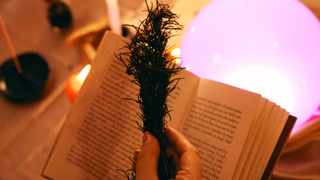

Alba is on the floor. Not metaphorically - physically, on the cold floor of a cell whose walls she has memorized by touch, in a country that has decided to forget she exists. Around her, or perhaps only inside her, the notebooks are spread open. Yellowed pages, torn edges, handwriting that changes the way a river changes as it moves from mountain to plain. Her grandmother Clara’s hand is here, steady and precise in the early pages, then looser, more luminous, as though the older she grew the less she needed to stay inside the lines. And now Alba adds her own hand to the record, not above or below Clara’s words but alongside them, braiding one life into another until the two become a single unbroken thread.
She is not writing history. The generals write history. She is writing something they do not know how to confiscate: a family’s memory of itself. The color of the sky on a particular afternoon. The name of a dog. The way her grandmother smelled of lemon verbena and certainty. She writes because to forget would be a second dying, not only for herself but for every woman who pressed the story into her hands and said, without saying it, carry this forward. The pages are proof that someone was here. That someone paid close attention to this one, irreplaceable world. The most radical act in The House of the Spirits is not the magic or the revolution but the refusal to let pain have the final word. Alba writes through the night, and somewhere in the writing, the walls of the cell grow slightly less solid.
Most of us will never sit in a cell. But we know the particular fear of a world going quiet - a parent whose stories are fading, a language nobody young speaks anymore, a neighborhood that has shed its old skin and put on a stranger’s face. We feel the slow erosion of the particular, the way memory softens at the edges if no one is tending to it.
What Alba shows us, without sermon, is that remembering is not a passive thing. It is a daily decision, sometimes a costly one. The grandmother who insists on a full pantry is not being irrational. She is keeping a record in the only language available to her. The mother who copies recipes into a battered notebook is not being sentimental. She is reaching into the fire.
We all have notebooks we haven’t opened. Stories we half-know and mean to ask about. Phrases someone used that live now only in our mouths, surfacing unbidden, small visitations from the people who made us.
The house burns. The regime falls. The spirits come and go.
Something survives, if someone reaches for it.