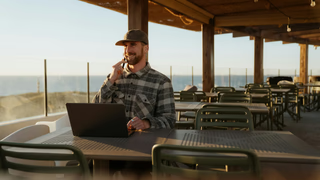
The apartment in Málaga’s Soho district still had six months on the lease. The coworking membership was paid through summer. The neighborhood baker had just started remembering the order: café con leche, tostada con tomate, no butter. Then, in early 2026, Spain’s revised digital nomad visa rules landed, and the spreadsheet that had made this life possible stopped making sense.
Spain’s income threshold for the digital nomad visa rose to roughly €2,850 per month, tied to 200% of the new minimum wage after a 3.1% increase in January 2026 [The Local]. Combined with tighter enforcement and reports of denials for self-employed founders, the change sent shockwaves through a community that had quietly turned Spanish cities into the world’s most desirable remote-work bases. Global nomadism is surging, yet the country that once rolled out the welcome mat is now asking a harder question about who gets to stay.
The Dream That Felt Permanent
When Spain launched its digital nomad visa in 2023, the message felt clear: come, work remotely, enjoy the Mediterranean, and contribute to local economies.
 Photo by
 Thousands responded. Remote workers from the US, UK, and Latin America filed applications, drawn by a combination no other European country quite matched: reliable internet, affordable rent outside the capital, world-class food, and EU access.
What started as a trial run became something deeper. Nomads signed year-long leases in Valencia’s Ruzafa neighborhood. They enrolled kids in local schools in Seville. They joined padel leagues in Málaga. Average stays stretched well beyond the three-month tourist window, reflecting genuine settlement intent.
The affordability equation drove all of it. Cities like Málaga and Valencia offered coworking spaces for €150 to €200 a month, apartments in walkable barrios under €1,000, and a quality of life that felt almost unfair compared to London or San Francisco. Spain wasn’t a stopover. It was a deliberate, long-term life choice built on real financial and emotional investment. That investment is precisely what made the rule change sting.
The Visa Hike Lands Hard
The revised numbers aren’t a bureaucratic footnote.
 Photo by
 Spain’s minimum wage increase pushed the income threshold to approximately €2,850 per month for a solo applicant [The Local]. That translates to over €34,000 annually in provable, documented income, before taxes, before rent, before the mandatory private health insurance every applicant must carry.
For a senior software engineer billing $120 an hour, this is background noise. For a freelance graphic designer in Bogotá, a content writer from Lisbon, or an English tutor from the UK earning £2,200 a month, the math collapses. The visa was never cheap, but it had been reachable. Now it filters more aggressively.
The financial pressure compounds at renewal. Legal and administrative fees, including immigration lawyers in Barcelona, document translations, and apostilles, can easily rival a month’s rent. Bureaucratic complexity has deepened too. Some applicants report outright denials for self-employed founders who own or administer their own companies, a category covering a large share of the nomad population.
The practical breakdown:
-
Income threshold: ~€2,850/month for main applicant, 200% of Spain’s minimum wage [The Local]
-
Annual income proof: Over €33,000/year documented [Boundless HQ]
-
Spanish-source income cap: Only up to 20% of total professional income from Spanish clients
-
Self-employed owners: Reportedly facing increased denial rates for company administrators
-
Beckham Law window: Miss the six-month application deadline and you lose the tax benefit entirely
A Culture Caught Between Worlds
Walk through Barcelona’s Gràcia district or Málaga’s east side and the tension shows up on every rental listing.
 Photo by
 Apartments locals remember at €700 a month now advertise at €1,100 or more, with landlords openly preferring short-term nomad tenants who pay in foreign currency and don’t invoke Spain’s strong tenant protections.
For residents, the visa hike reads as overdue correction. Housing affordability protests have intensified across Spain’s coastal cities, and remote workers have become a convenient symbol of the problem. The frustration is real: families priced out of neighborhoods their grandparents built.
But the picture is more complicated. Many nomads had genuinely integrated. They learned Spanish, not tourist-menu Spanish, but the kind that lets you argue with your landlord about the boiler or chat with the woman at the frutería about her grandchildren. They spent money at local businesses. They volunteered. They stayed.
“Spain’s minimum wage has increased, and the income threshold is higher than in previous years.”
That dry legal observation masks a real tension. Spain’s government is caught between two legitimate needs: attracting high-spending international residents who boost GDP, and protecting housing access for its own citizens. The visa hike attempts to thread that needle but satisfies neither side completely. Further adjustments remain likely, which means the uncertainty isn’t going away.
Nomads Rethink Their Next Move
The instinct is to search for the next Spain.
 Photo by
 Portugal ended its Golden Visa program in 2023 and has signaled stricter nomad income enforcement. Georgia remains visa-friendly but lacks EU access. Mexico offers affordability and culture but brings bureaucratic headaches and safety considerations. Southeast Asian hubs like Chiang Mai and Bali deliver on cost but sit twelve time zones from European clients.
No single destination replicates what Spain offered: EU membership, Mediterranean climate, affordable living, strong digital infrastructure, and a deep, walkable urban culture that made daily life feel rich rather than transactional.
Some nomads are absorbing the higher costs and staying put. Community groups in Málaga and Valencia report that a meaningful portion of affected members plan to renew regardless, citing years of social roots, language progress, and the sheer friction of starting over. The sunk costs aren’t just financial. They’re relational.
Others are using the disruption as a forcing function. A growing cohort is stepping back from pure nomadism, exploring hybrid models with a fixed home base and periodic travel, or returning home with a clearer sense of what they valued about mobile life. The search for Spain’s replacement turns out to be a search for clarity about what nomads want their lives to look like.
What Home Really Means Now
The deeper wound isn’t about euros.
 Photo by
 It’s about identity.
Nomads who built their self-concept around freedom of movement are confronting an uncomfortable truth: the freedom to leave is not the same as the freedom to stay. Spain had temporarily resolved a tension at the heart of nomadic life, the pull between constant motion and the deeply human need for stable community, for a place where people know your name and your coffee order.
Expat therapists in Barcelona and Valencia have noted increased demand from clients processing what some describe as displacement grief: mourning not just a location, but a version of themselves that felt settled, productive, and whole. That grief doesn’t fit neatly into the nomad narrative of agility and reinvention.
The nomads navigating this moment most thoughtfully aren’t treating the visa hike as a betrayal. They’re treating it as data: evidence that the next chapter requires a more intentional relationship with place, community, and permanence.Living somewhere, really living there rather than passing through, means accepting that the place can change the terms on you. Spain just did.
The visa hike exposed the fragility beneath the nomad dream: the financial assumptions that barely held, the cultural tensions that were always simmering, and the quiet longing for permanence that constant mobility can’t fully satisfy. The most useful starting point isn’t a destination comparison spreadsheet. It’s a harder, more personal question: what do you actually need from a place, not just what does it cost?
The best nomads aren’t those who never stop moving. They’re the ones who know exactly why they stay.