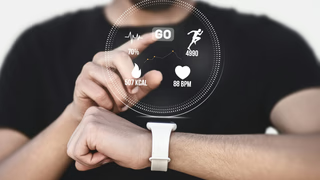
77% of workers now experience work-related stress, with 57% reporting emotional exhaustion and vanished motivation [LifeX]. That figure tells a clear story about what modern life has done to the human nervous system: a system built for short bursts of danger, not perpetual digital siege. In 2026, the consequences are no longer abstract. Nearly 30% of adults report chronically high stress levels [Mindful Leader], and the fallout, including disrupted sleep, cognitive fog, and eroded resilience, has become so widespread it barely registers as abnormal. Against this backdrop, a movement called neurowellness has emerged as one of the defining wellness trends of the year [NIH/PMC]. It goes beyond traditional stress management to target nervous system regulation as the foundation of human health. The question is whether it can deliver on that promise, or whether it risks becoming another individualized fix for structural problems.
Fight-or-Flight Became Our Default Setting
The autonomic nervous system doesn’t distinguish between a predator and a push notification.
 Photo by
 Both trigger the same cascade: cortisol surges, heart rate spikes, digestion slows, and the prefrontal cortex dims its activity. That region handles calm reasoning. This is the fight-or-flight response, built for emergencies that lasted minutes, not lifetimes.
Before the always-on era, recovery was built into daily life. Work ended. Evenings were quiet. The nervous system cycled naturally between activation and rest. That architecture has collapsed. Research from the Global Wellness Summit found that 78% of healthcare practice leaders reported increased stress levels over 2025, with 36% saying they never disconnect from work [MIT]. When recovery windows vanish, the body doesn’t simply endure. It adapts. Sympathetic dominance becomes the new baseline, and hyperarousal starts feeling normal.
The downstream effects are measurable and cascading:
-
Chronic cortisol elevation impairs memory consolidation and emotional regulation
-
Sustained hypertension and increased inflammatory response contribute to cardiovascular disease [Mindful Leader]
-
Sleep architecture fragments, reducing the deep-rest phases needed for neural repair
-
Immune resilience declines as metabolic resources shift toward threat response
This isn’t a story about individual weakness. It’s a story about a biological system operating exactly as designed, in an environment it was never designed for. Recognizing that mismatch at a cultural scale is what catalyzed the neurowellness movement’s rapid ascent.
Neurowellness Emerges as the Cultural Answer
Earlier wellness waves often traded in vague positivity: gratitude journals, affirmation apps, mindfulness marketed as a productivity hack.
 Photo by
 Neurowellness departs from that tradition by anchoring itself in measurable physiological states. Heart rate variability (HRV), vagal tone, and cortisol rhythms become the metrics that matter, shifting the conversation from “think better” to “regulate your nervous system.”
“Neurowellness is no longer a niche. It’s becoming the foundation of how we understand health, performance, and longevity. Today, we can measure brain states in real time. We can influence them.” [Grow Therapy]
This data-grounded approach lends the movement a credibility that previous wellness trends often lacked. The tools are also diversifying rapidly. In December 2025, the FDA granted its first premarket approval for the Flow Neuroscience headset, a home-use transcranial direct current stimulation (tDCS) device designed to treat major depressive disorder [WCHSB]. That regulatory milestone signaled something important: nervous system interventions are moving from fringe to clinical mainstream.
Lower-tech practices are gaining traction alongside the devices. Somatic breathwork, cold exposure protocols, and vagal nerve stimulation exercises require no prescription and minimal time. A structured breathing technique called cyclic sighing, for instance, has drawn research attention for its ability to shift autonomic state within minutes.
The corporate world has noticed. 76% of employers are increasing mental health spending, shifting away from standalone apps toward tiered support models and stress resilience resources [Risk Management]. The behavioral insight driving this is straightforward: a dysregulated nervous system undermines cognitive performance, collaboration, and retention regardless of how many meditation sessions an app delivers.
Yet widespread enthusiasm also invites legitimate scrutiny about what the movement can and cannot deliver.
Counterpoints and Honest Limitations
The gap between neuroscience and its popularized translation is often wider than consumers realize.
 Photo by
 Complex frameworks like polyvagal theory get compressed into social media carousels that strip away clinical nuance. HRV data from consumer wearables gets interpreted without the context a trained clinician would provide. The risk isn’t just inaccuracy. It’s misplaced confidence in self-diagnosis and self-treatment.
Accessibility presents another fault line. Wearable biofeedback devices, somatic therapy sessions, and neurostimulation headsets carry price tags that place them firmly in affluent-consumer territory. When nervous system regulation becomes a premium product, the people most affected by chronic stress, those navigating poverty, discrimination, and housing insecurity, are least likely to access the tools designed to address it. This mirrors a broader pattern in wellness culture: the communities bearing the heaviest allostatic load receive the fewest resources.
Perhaps the most important tension is philosophical. Positioning nervous system regulation as an individual responsibility risks obscuring the organizational, political, and economic conditions that generate chronic stress in the first place. A breathwork practice cannot compensate for an exploitative work schedule. An HRV monitor doesn’t fix systemic inequity. 35% of HR and benefits leaders already acknowledge that AI is driving employee stress and job anxiety, a structural force no amount of personal regulation can neutralize.
This doesn’t invalidate the tools. It does demand honesty about their scope. Somatic practices are most effective as complements to systemic change, not substitutes for it. Acknowledging that boundary is what separates a durable wellness paradigm from a passing cultural trend.
Building a Regulated Future
The most promising trajectory for neurowellness in 2026 isn’t individual or systemic in isolation.
 Photo by
 It’s both, operating simultaneously at different scales.
At the organizational level, nervous-system-informed design is beginning to reshape how workplaces function. This means more than offering a meditation room. It means restructuring notification cultures, building genuine recovery time into workflows, and training managers to recognize dysregulation patterns in their teams. The 76% of employers increasing mental health spending [Risk Management] represent a meaningful resource shift, but the impact depends on whether that spending targets root causes or merely adds another app to the benefits portal.
At the educational level, pilot programs teaching HRV awareness and breathwork to adolescents are emerging in several countries. The behavioral logic is compelling: when regulation skills are taught early and universally, they cease to be a wellness luxury and become a public health foundation. Nervous system literacy, understanding what activation feels like and knowing how to return to baseline, is as fundamental as nutritional literacy, and arguably more neglected.
At the policy level, the conversation is just beginning. Neural data privacy laws are already under development as consumer neurotechnology expands , raising questions about who owns the biometric data generated by wellness devices and how it can be used.
The integrated model looks something like this:
- Individual practice: breathwork, somatic tools, and biofeedback as daily regulation habits
- Organizational redesign: workplaces structured to reduce chronic threat activation
- Educational investment: nervous system literacy embedded in school curricula
- Policy frameworks: equitable access provisions and neural data protections
None of these layers works in isolation. A regulated future is built breath by breath and institution by institution, with personal agency and collective responsibility reinforcing each other rather than competing.
Chronic fight-or-flight activation is a defining psychological challenge of modern life. Not because people are fragile, but because the environments we’ve built are relentlessly activating. Neurowellness offers a scientifically grounded, culturally resonant response, one that finally speaks the language of the nervous system rather than asking it to simply cope harder. Its tools show genuine promise. Its limitations deserve equal honesty. Starting with one regulation practice this week, a few minutes of structured breathing, a phone-free morning, or simply noticing your baseline state, offers a small but tangible entry point. Regulation is not a retreat from the world. It is the foundation from which we engage it more fully.
Sources
- LifeX Research Insights on Neurowellness Trends, OpenPR 2026
- Mindful Leader Spring Pulse Report on Stress and Health 2026
- Risk Management Magazine: Neural Data Privacy and Workplace Mental Health 2026
- Global Wellness Summit: The Rise of Neurowellness Master Class 2026
- NIH/PMC: Neurowellness as Top 2026 Wellness Trend
- WCHSB Insights: FDA Approval of Flow Neuroscience tDCS Headset 2025
- Grow Therapy: Mental Health Trends and Neurowellness 2026