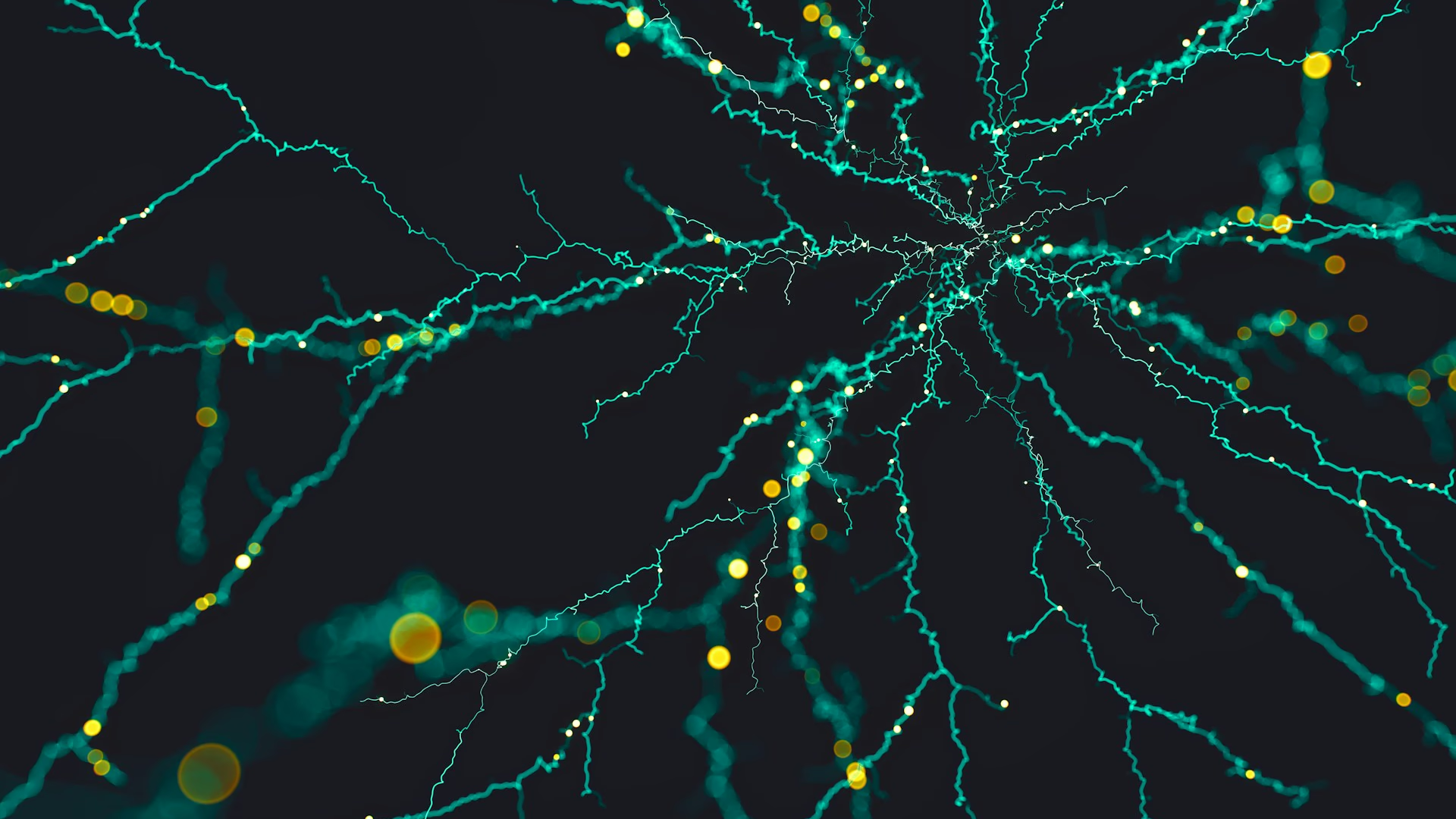
“I before e except after c” breaks down fast. Weird. Seize. Caffeine. That confusion wasn’t a glitch in your memory. A study published in 『PNAS』 reveals that the brain processes rules and exceptions through two anatomically distinct neural pathways. For the first time, researchers captured both systems operating in real time within living human brains. The finding translates computational models of hippocampal function into testable predictions, marking a significant turn in cognitive neuroscience [University of Toronto]. It also challenges a widely held assumption: that learning is one unified process happening in one place.
Two Pathways, One Learning Brain
 Photo by
 The common belief is intuitive. When you learn something new, your brain files the rule and its exceptions into the same cognitive folder, managed by roughly the same neural machinery. Decades of memory research reinforced this view by focusing on broad categories like declarative memory and procedural memory, both thought to share significant neural real estate in the hippocampus and prefrontal cortex.
The new imaging data tells a more divided story. Rule-based learning, the kind that detects statistical regularities across repeated exposures, engages a corticostriatal pathway: a loop connecting the cortex to the basal ganglia. This system is built for pattern generalization. See enough examples, extract the underlying structure, apply it forward.
Exceptions take a different route entirely. When learners encounter items that violate a previously established rule, the hippocampal-cortical pathway activates. This system encodes specific, episodic memories rather than generalizable patterns. The hippocampus essentially acts as a conflict-flagging mechanism, tagging the anomaly for special storage.
“One pathway is important in extracting regularities in learning, and the other is important for encoding exceptional items.” [University of Toronto]
Evolution appears to have built a division of labor into how the brain manages knowledge: one system for the rule, another for everything that breaks it.
What the Imaging Study Actually Found
Previous fMRI studies averaged brain activity across entire learning sessions, which blurred the moment-to-moment switching between these two systems.
 Photo by
 The new methodology combined high-resolution fMRI with trial-level computational modeling, allowing researchers to isolate activation signatures for each pathway on a single-exposure basis. That’s a first in human learning neuroscience [University of Toronto].
Participants categorized illustrated flowers as preferring sun or shade based on features like petal shape or inner circle color. They learned the rules first, then encountered exceptions. Researchers tracked “functional footprints”: patterns of activation reflecting how many neural messengers traveled through each pathway at any given moment.
The MSP (monosynaptic pathway) was most active during initial rule-learning. Later, TSP (trisynaptic pathway) activation increased as exceptions were introduced, and stronger TSP activation correlated directly with better exception learning .“Moment to moment, there are multiple messengers. The more messengers that go through a particular pathway, the stronger the footprint is going to look.”
“It was almost like the MSP was building this knowledge base, the foundation, and then later on in learning the TSP added these exceptional items into a scaffold of knowledge.”
The brain doesn’t deliberate about which system to deploy. The routing appears automatic and pre-conscious, a neural arbitration system that older imaging methods were too blunt to detect.
Why This Shifts How We Teach
Most curricula introduce a rule and its exceptions together.
 Photo by
 Grammar lessons pair regular verb conjugations with irregular forms in the same session. Medical training presents typical disease presentations alongside atypical ones from the start. The assumption: give learners the full picture early.
The neuroimaging data suggests this approach may undermine retention of both rules and exceptions. The two pathways appear to operate in a staged, sequential fashion. Rules consolidate first; exceptions layer on afterward. Activating the exception-encoding system too early could interfere with rule consolidation before it stabilizes.
Research in language acquisition supports this. Delayed exception introduction has been shown to improve both rule fluency and exception recall compared to simultaneous presentation. The new study offers a mechanistic explanation for why staged learning works:
-
Rules first: High-repetition, low-variability practice strengthens the corticostriatal pathway’s pattern-detection capacity.
-
Exceptions second: Introduced only after the rule foundation has consolidated, allowing the hippocampal system to work without suppressing the rule pathway.
-
Spacing matters: The gap between rule consolidation and exception introduction gives each system room to do its work.
This reframes not just classroom teaching but any structured training environment, from corporate onboarding to athletic coaching to self-directed study.
Rethinking Learning From the Inside
For individual learners, the most actionable insight is deceptively simple: identify whether what you’re studying is a rule or an exception, then choose your method accordingly.
 Photo by
 Rule-heavy material, such as grammar patterns, math formulas, or coding syntax, benefits from high-repetition, low-variability practice that reinforces the corticostriatal pathway’s gradual strengthening. Spaced repetition systems are particularly effective here because they exploit exactly this cognitive architecture.
Exception-heavy material, including irregular verbs, edge-case medical diagnoses, and legal precedents, calls for a different approach. Vivid, contextually rich encoding engages the hippocampal system’s episodic strengths. Narrative-based case studies, memory palace techniques, and elaborative storytelling tend to outperform flashcard drilling for this type of content, consistent with how the hippocampus prefers to store information.
The broader implication is a shift from effort-based to pathway-aware learning. Working harder matters less than working in alignment with the brain’s own architecture. This doesn’t mean studying less. It means studying with the grain of your neuroscience rather than against it.
“I’m excited about applying the pathway footprints method to different questions and looking in different regions of the brain.”
The researchers see this as a beginning. The functional footprints method could eventually map how these pathways behave in clinical populations, including people with amnesia, learning disabilities, or neurodegenerative conditions, offering diagnostic precision that currently doesn’t exist.
The brain was never confused by “weird” and “receive.” It was running two systems at once, exactly as designed: one extracting the pattern, the other flagging the violation. What changed is that scientists can now watch both systems in action, in living human brains. For anyone who has ever studied hard and still struggled with irregularities, the research offers a different kind of reassurance: the difficulty wasn’t a failure of effort. It was a signal that your brain needed a different pathway activated.