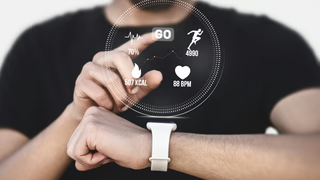
You wake to an alarm, rush through breakfast by 7:30, and squeeze life into calendar blocks. Sound familiar? Most of us treat our smartphones like personal drill sergeants, checking the time dozens of times daily and forcing ourselves through tasks regardless of how we actually feel.
But what if your body has a better schedule than your calendar? Chrono-living means aligning your daily activities with your natural biological rhythms rather than arbitrary clock times. It’s about working with your body instead of against it. The results can transform your energy, productivity, and overall well-being.
Clock Tyranny in Modern Life

Think about yesterday. How many times did you glance at a clock, phone, or watch? For most people, it’s nearly 50 times daily. We’ve turned time into a taskmaster rather than a tool, and our bodies are paying the price.
This constant time-checking creates a disconnect from our internal cues. When the clock says noon, we eat whether hungry or not. When it says 6 AM, we drag ourselves awake, regardless of sleep quality. Research shows this time-anxiety correlates with increased cortisol levels and decision fatigue throughout the day.
Even more striking: forcing productivity during low-energy hours can waste up to 40% of our cognitive capacity compared to peak times. That report you struggled with for two hours at 3 PM? It might have taken half the time during your natural energy peak. Clock-based living ignores your body’s wisdom, creating unnecessary stress and inefficiency.
Your Body’s Natural Rhythms
Here’s the good news: your body already knows when you perform best.
 Photo by
 Every person has innate circadian rhythms. These 24-hour cycles regulate hormone release, body temperature, and alertness independently of external schedules.
Scientists recognize three main chronotypes: morning types, evening types, and intermediate types [NIH]. Morning larks typically peak cognitively between 8-11 AM, while night owls hit their stride from 6-9 PM. Intermediate types fall somewhere in between. These patterns aren’t personality quirks. They’re genetic variations that determine whether you’re naturally early or late-oriented.
Your core body temperature peaks 2-3 hours before your natural bedtime, signaling prime performance windows. Research even shows that under natural daylight, our bodies burn more fat around 1:00 PM [Physoc]. Meanwhile, Professor Joris Hoeks notes that “we largely spend our days under artificial lighting, which has a lower light intensity and a narrower wavelength spectrum than natural light” [Physoc]. This further disrupts our natural rhythms.
Breaking Free From Time Boxes
Transitioning to chrono-living doesn’t require quitting your job or abandoning all schedules.
 Photo by
 It starts with awareness.
Try this: track your energy levels hourly for one week without changing any behavior. Simply rate yourself 1-10 at each hour. Most people discover consistent peaks and valleys they’d never consciously noticed. Maybe you’re sharp at 9 AM but foggy by 2 PM. Perhaps your creativity surges after dinner.
Once you know your patterns, start small. Consider claiming one flexible time block weekly where you work according to energy rather than the clock. Use that window for your most important creative or strategic work. This gradual approach makes chrono-living sustainable even in structured work environments where you can’t control everything.
Designing Your Chrono Life
A sustainable chrono-living practice matches high-stakes tasks to peak energy windows while protecting low-energy periods for restoration.
 Photo by
 It often helps to schedule creative and strategic work during your personal peak hours. For most people, that’s typically 2-4 hours after waking. Reserve your cognitive prime time for what matters most, whether that’s writing, problem-solving, or important conversations.
The post-lunch dip between 1-3 PM happens to nearly everyone due to circadian biology. Instead of fighting for focus, use this time for administrative tasks, light exercise, or social connection. Work with the dip, not against it.
Finally, you might consider protecting your evening transition. Create a wind-down routine before natural sleepiness hits. Dr. Thomas Marjot warns that consuming lots of calories just before bed, when the body is less able to process food efficiently, means that sugar and fat are more likely to end up being stored in the liver. The same principle applies to mental stimulation. Blue light exposure within two hours of sleep can delay melatonin release significantly.
Chrono-living replaces clock tyranny with biological wisdom. By tracking your energy patterns and gradually adjusting activities to match your natural rhythms, you can reclaim productivity and reduce daily stress.
This week, consider tracking your energy hourly and identifying one task you could move to your peak performance window. Your body already knows the best time for everything. You just need to start listening.