Picture a classroom where every student gets exactly the lesson their brain needs at the right moment. This isn’t science fiction. It’s happening now in schools worldwide. For decades, education treated all brains identically, delivering the same content at the same pace. But neuroscience reveals a different truth: each brain processes information uniquely, with distinct patterns of attention, memory formation, and motivation.
Modern EdTech is catching up. By applying brain science principles, developers create learning experiences that work with our neural wiring rather than against it. The results are transforming education itself.
Brain Science Meets Digital Learning
Understanding how neurons fire and connect transforms platform design from guesswork to science.

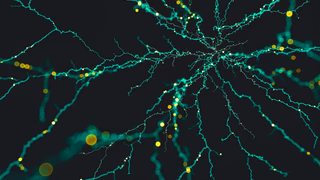
Neuroplasticity research shows our brains physically rewire through learning. Synaptic connections strengthen with repeated exposure and active engagement. Think of it like building a path through a forest. The more you walk it, the clearer it becomes.
This isn’t abstract theory. It’s the foundation of how EdTech structures content delivery. Cognitive load theory offers another crucial insight. Working memory holds only 4-7 items simultaneously. When we overload this capacity, learning grinds to a halt. It’s like juggling too many balls. Eventually, they all crash down.
Smart platforms now chunk information into digestible pieces, preventing the mental traffic jam that occurs when too much hits the brain at once. Carnegie Learning and Sana Labs lead this charge, offering neuroscience-based AI platforms that adapt to individual processing patterns.
The shift is measurable. Schools using AI-assisted curriculum design report up to 18% improvement in student performance on standardized assessments. These aren’t marginal gains. They represent a fundamental alignment between how we teach and how brains actually learn.
Memory Formation and Spaced Repetition
Here’s an uncomfortable truth: we forget 70% of what we learn within 24 hours.
 Photo by
 The forgetting curve is steep and unforgiving, which explains why cramming rarely works for long-term retention. But neuroscience offers a powerful countermeasure called spaced repetition.
Instead of cramming information in marathon sessions, spaced repetition schedules reviews at optimal intervals. The technique catches knowledge just before it slips away, reinforcing neural pathways when they need strengthening most. Leading platforms automate this timing based on individual performance, creating personalized review schedules that match each learner’s memory consolidation pace.
Timing matters in another way too. Sleep-dependent memory consolidation means information reviewed before sleep shows dramatically better retention than late-night cramming. The brain doesn’t just rest during sleep. It actively reorganizes and strengthens neural pathways formed during the day. EdTech that respects circadian rhythms and encourages strategic study timing uses this natural consolidation process, helping learners retain more with less effort.
Attention Spans and Microlearning Design
Attention isn’t infinite. Brain attention systems peak at 10-15 minutes before declining, as sustained focus burns through glucose and mental energy.
 Photo by
 This explains why hour-long lectures feel like endurance tests rather than learning experiences.
Microlearning modules work with this natural rhythm. By delivering focused content in bite-sized sessions that match attention cycles, these modules allow better encoding and reduce cognitive fatigue. Breaking material into shorter segments gives the brain time to process and consolidate information between sessions.
The brain’s reticular activating system adds another layer of complexity. This neural filter constantly prioritizes novel and relevant stimuli while tuning out repetitive content. Varied formats and interactive elements trigger attention networks more effectively than passive reading, which is why effective EdTech incorporates videos, quizzes, simulations, and text rather than relying on a single format.
However, there’s a darker side. Neuroscientist Jared Cooney Horvath warns that excessive technology use in education may contribute to cognitive decline, suggesting “this is the first generation in a millennium to be worse off than their parents”. The challenge isn’t just capturing attention. It’s doing so in ways that build rather than erode cognitive capacity over time.
Dopamine Loops and Gamification Systems
Dopamine drives motivation, but not in the way most people think.
 Photo by
 This neurotransmitter releases during anticipation of rewards, not just achievement. Progress bars, streaks, and unlockable content tap into this anticipation, making the learning journey itself motivating rather than just the destination.
Variable reward schedules, where outcomes aren’t entirely predictable, trigger stronger dopamine responses than guaranteed rewards. This explains why well-designed gamification keeps learners engaged session after session. However, the same mechanism that motivates can also create unhealthy dependency patterns if not carefully balanced.
Effective gamification balances extrinsic rewards like badges, points, and leaderboards with intrinsic motivation such as mastery, autonomy, and purpose. Over-reliance on external rewards can undermine long-term learning motivation and curiosity. The goal is to use dopamine wisely, creating engagement that transitions from external validation to genuine interest in the subject matter.
Personalized Learning Through Neural Insights
Brain imaging reveals what educators have long suspected: we don’t all learn the same way.
 Photo by
 fMRI studies show different brain regions activate for visual, auditory, and kinesthetic learners during information processing. This goes beyond simple preference to actual neural efficiency. Some brains genuinely process certain types of information more effectively than others.
Adaptive platforms now adjust content format based on which presentation style yields best comprehension for each individual. AI algorithms analyze response patterns to identify optimal difficulty levels, maintaining the “flow state” sweet spot where challenges slightly exceed current skill level without triggering frustration.
The adoption is accelerating rapidly. AI integration shows large positive effects on learning outcomes, with a 2025 meta-analysis finding an effect size of 0.86, and chatbots and generative AI showing even higher effects at 1.02. The number of K-12 educators classified as “AI power users” nearly doubled from 22% in 2024 to 43% in 2025.
Yet personalization brings risks worth considering. Researcher Tapani Rinta-Kahila cautions that overreliance on generative AI may damage memory retention and critical thinking over time by reducing active cognitive effort. The technology should scaffold learning, not replace the cognitive work that builds neural pathways and develops deeper understanding.
Multisensory Learning and Interactive Content
Dual coding theory reveals a powerful principle: combining visual and verbal information activates separate memory systems, improving retention significantly.
 Photo by
 Students remember 65% of visual-verbal content versus just 10% of text-only material after three days. This dramatic difference shows why multimedia learning is so effective.
Interactive simulations take this further by activating motor cortex alongside cognitive regions. This embodied learning creates stronger memory traces through physical engagement, whether that’s manipulating objects in a virtual environment or solving problems through hands-on interaction. VR and AR experiences demonstrate this dramatically, showing 75% retention rates compared to 10% for traditional lecture-based learning.
Cross-modal learning strengthens neural pathways by creating multiple retrieval cues for the same information. When you learn a concept through reading, watching a video, and practicing in a simulation, your brain builds multiple access points to that knowledge. It’s like having three different roads leading to the same destination. If one route is blocked, you have alternatives. Modern EdTech platforms use this by integrating multimedia experiences that engage multiple sensory pathways simultaneously.
Future Directions for Brain-Based EdTech
The next frontier involves real-time neural monitoring that could revolutionize personalized learning.
 Photo by
 EEG headsets and wearables will track attention, stress, and comprehension levels, adjusting content difficulty dynamically. Early prototypes already detect confusion patterns and automatically provide additional explanations or examples when learners struggle.
Brain-computer interfaces may eventually enable direct neural feedback, optimizing learning states through neurofeedback training. Research shows neurofeedback can improve focus and reduce anxiety in learning environments, helping students achieve better mental states for learning.
But as technology advances, critical questions emerge about its proper use. With 60% of teachers integrating AI into daily teaching practices and over 53% of higher education students using generative AI tools for academic work, we need to ensure these tools improve rather than replace cognitive development. As one researcher warns, “students uncritically using the technology and handing over the necessary cognitive work to the machine” poses risks to deep learning.
The challenge moving forward is creating EdTech that uses neuroscience to strengthen minds, not just deliver content efficiently. Technology should be a tool that amplifies human learning capacity, not a crutch that weakens it.
Neuroscience is transforming EdTech from one-size-fits-all to brain-optimized learning. By using insights about memory consolidation, attention cycles, dopamine motivation, and personalized neural patterns, modern platforms create educational experiences aligned with how we actually learn. The results are promising with measurable improvements in retention, engagement, and outcomes across diverse learning environments.
Yet the technology demands wisdom in application. The goal isn’t just efficient content delivery, but building stronger, more capable minds that can think critically and learn independently. As you explore learning tools for yourself or others, ask: Do they incorporate spaced repetition, respect attention limits, and personalize based on neuroscience principles? Do they encourage active cognitive engagement rather than passive consumption?
The future of education isn’t just digital. It’s neurologically informed, adapting to each unique brain while preserving the cognitive effort that makes learning stick. When we align technology with brain science, we create learning experiences that don’t just transfer information, but fundamentally strengthen our capacity to learn, think, and grow.