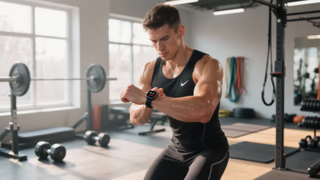

The moment Jake checked his running app after his morning 5K, everything changed. For months, he’d been stuck at the same pace, pushing harder but seeing no improvement. Then he noticed something his fitness tracker had been trying to tell him all along: his heart rate zones showed he’d been training too hard, too often. Within eight weeks of adjusting his intensity based on this simple data point, Jake shaved two minutes off his time.
This breakthrough isn’t unique to Jake, recreational athletes everywhere are discovering that a few key metrics can unlock performance gains that years of traditional training couldn’t achieve. What’s driving this shift is the democratization of sports science tools that were once exclusive to professional teams.
Market Growth and Accessibility
Contrary to popular belief, data-driven training isn’t just for professional athletes with million-dollar contracts.

According to industry projections, the sports analytics industry is on track to surpass $31 billion by 2034, and recreational athletes are driving significant portions of this growth.
What’s fueling this expansion? The results speak for themselves. Professional sports teams using advanced performance tracking have reported up to a 15% increase in player performance, according to various reports. When amateur athletes see these kinds of improvements becoming accessible through consumer technology, adoption rates skyrocket.
Here’s what makes this particularly relevant for recreational athletes: your local running club probably has members tracking metrics that Olympic athletes couldn’t access twenty years ago. The technology gap between professional and amateur sports is closing rapidly, creating unprecedented opportunities for performance improvement.
The beauty of modern sports analytics lies in its accessibility, you don’t need a sports science degree to benefit from data that was once confined to research laboratories.
Scientific Foundation and Practical Applications
Consider Sarah, a recreational cyclist, who always wondered why her Saturday group rides left her exhausted for days while her friend Tom seemed to recover overnight.
 Photo by Franco Monsalvo on Pexels
The answer came from heart rate variability (HRV) monitoring, a metric that shows when your body is ready for intense training versus when it needs recovery.
This approach is grounded in solid science. Advanced statistical models and machine learning algorithms are now commonplace in sports, allowing teams to optimize training regimens. The same principles that help professionals can transform recreational training as well.
Motion capture technology offers another compelling example. What was once confined to biomechanics labs now fits in your smartphone, helping runners identify inefficient movement patterns that waste energy and increase injury risk. This represents a fundamental shift in how athletes at all levels can access performance insights.
Interval training optimization demonstrates the practical value of this approach. Instead of guessing how long to rest between sprints, power meters and heart rate monitors provide precise feedback on recovery status. Some athletes discover they’ve been resting too long, limiting workout effectiveness. Others learn they need more recovery than they thought, explaining persistent plateaus.
Professional Implementation Models
When you watch an NBA game, you’re seeing the results of intensive data analysis in action.
 Photo by Paulo Guilherme Mouta on Pexels
NBA teams leverage data analytics for player development and tactical planning, transforming how the game is played at every level. Players now know their optimal shooting spots down to the inch, with training programs targeting these specific zones for improvement.
What makes this relevant for recreational athletes is the technology’s democratization. Amateur basketball teams now employ machine learning to evaluate shot selection and defensive effectiveness, using smartphone apps that cost less than quality basketball shoes. Local leagues are seeing measurable improvements in team performance simply by tracking basic metrics like shot location and defensive positioning.
The swimming world provides another compelling case study. Waterproof sensors that track stroke rate, distance per stroke, and turn efficiency were once exclusive to Olympic training centers. Today, masters swimmers in their 60s use these same metrics to improve technique and set personal records. One swimming club reported that members using stroke analysis improved their 100-meter times by an average of 3 seconds, massive gains in a sport where improvements are typically measured in tenths of seconds.
Implementation Framework for Recreational Athletes
You can begin improving with data today, without significant investment or technical expertise.
 Photo by david hou on Pexels
The most effective approach focuses on three fundamental metrics that apply to almost any sport: heart rate, movement speed, and recovery time. Your smartphone likely already tracks two of these without additional equipment.
Mark, a weekend tennis player, started by simply recording his heart rate during matches using a basic fitness watch. He discovered his heart rate spiked unnecessarily high during service games, not from physical exertion, but from mental pressure. This insight led him to incorporate breathing exercises between points, ultimately improving both his serve percentage and endurance.
Progressive Implementation Strategy
Week 1: Track your resting heart rate each morning to establish baseline data
Week 2: Add workout intensity zones to understand training stress
Week 4: Correlate sleep quality with performance metrics
Each data point contributes to your performance story. Some people discover they perform best with nine hours of sleep, while others thrive on seven. Some need two rest days after intense workouts; others recover faster with active recovery sessions.
The goal isn’t to become obsessed with spreadsheets, it’s about identifying the two or three metrics that provide the most actionable insights for your specific goals and lifestyle.
Moving Forward with Data-Driven Training
The gap between professional and recreational sports training continues to narrow, with data serving as the primary bridge.
 Photo by Mikhail Nilov on Pexels
You don’t need expensive equipment or complex software to access the same principles that help elite athletes win championships.
Whether you’re training for your first 5K or improving your weekend basketball game, well-chosen metrics can accelerate progress beyond what traditional training alone could achieve. The key is starting with simple, actionable data points and building gradually as you learn what works for your body and goals.
You can begin tomorrow morning: check your resting heart rate, note how you feel, and start building your own performance story. The insights you discover might surprise you, just ask Jake, who’s now training for his first marathon, guided by data he never knew he needed.