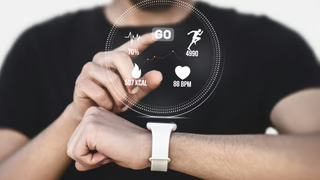
42% of adults now wear a fitness tracker, and that number keeps climbing [ACSM]. That single statistic explains why 2,000 clinicians, researchers, and exercise professionals surveyed by the American College of Sports Medicine ranked wearable technology the #1 fitness trend for 2026 [ACSM]. Not strength training. Not group classes. Not HIIT. The device on your wrist beat them all.
This is not a fluke. The ACSM’s annual Worldwide Fitness Trends survey carries real weight because its respondents span every corner of the profession: personal trainers, exercise physiologists, coaches, and clinical specialists across dozens of countries. Their 2026 consensus reflects something fitness professionals have been watching for years. Wearables have moved from novelty gadgets to serious performance tools.
What the Experts Actually Agree On
 Photo by
 The survey’s breadth matters here. Wearable technology held a top-three rank across nearly all professions and age groups surveyed [ACSM]. That kind of cross-discipline agreement is rare in an industry where trainers, physiologists, and clinicians often prioritize very different tools.
What unites them is a shared observation: clients and athletes who use wearables engage differently with their training. The data loop works like this: track a metric, adjust behavior, see results. No static workout plan replicates that cycle. Advanced biosensors now capture heart rhythm, blood pressure, blood glucose, skin temperature, and even fall detection . These are clinical-grade measurements delivered in real time, not fitness gimmicks.
“Your workout in 2026 will no longer be planned around guesswork. It will be programmed by your own physiology, updated in real time by the data your wearables already collect.” Dr. Vickey, exercise physiologist [Fitnessdrum]
That quote captures the common thread running through expert responses: wearables shift training from estimation to evidence.
Where Professionals Diverge
Not every expert sees wearables the same way.
 Photo by
 The divergence centers on a question the ACSM itself has acknowledged: nearly half of U.S. adults now own a fitness tracker or smartwatch, so the question is no longer whether people will use wearables. It is whether they will use them well .
Some professionals view wearables primarily as accountability tools, devices that keep clients consistent by making recovery, sleep, and endurance metrics visible between sessions. Others treat them as coaching instruments, using heart rate variability and readiness scores to program training loads day by day.
A third camp raises a fair concern: data without context can mislead. A low recovery score could prompt someone to skip a workout they actually need. A high step count can mask poor movement quality. The technology delivers numbers; interpretation still requires human expertise.
These tensions are healthy. They reflect a profession working out how to integrate powerful tools without losing the nuance of individualized coaching.
Why This Ranking Feels Different
Wearables topped the ACSM list before, first in 2016, then repeatedly in subsequent years.
 Photo by
 Each return to the top coincided with a leap in device capability, from basic step counting to full biometric suites. The 2026 ranking arrives at a different point, though.
Three factors separate this year from earlier appearances:
-
Sensor sophistication has crossed a real threshold. Blood glucose monitoring, ECG readings, and skin temperature tracking now come standard on consumer devices .
-
Adoption density has reached critical mass, with 42% of adults already wearing a device [Newsiness], up from single digits a decade ago.
-
Professional integration is no longer treated as optional. Trainers and coaches increasingly build programming around client wearable data rather than treating it as supplementary.
This convergence of capability, adoption, and professional buy-in separates the 2026 ranking from earlier appearances. The trend is not cycling back. It is compounding.
Making Wearable Data Work
For anyone looking to get more from a wearable, the expert consensus points toward simplicity first.
 Photo by
 Rather than chasing every available metric, focusing on one, whether resting heart rate, sleep quality, or daily recovery score, builds the data literacy needed to unlock more advanced features over time.
Fitness professionals working with clients might consider incorporating wearable data into session planning. A client’s overnight HRV reading, for instance, can inform whether to push endurance work or dial back to mobility and recovery. That kind of real-time adjustment was once reserved for elite sport. Now it’s accessible to anyone with a smartwatch.
The strongest takeaway from the ACSM’s 2026 survey is not that wearables are popular. It is that 2,000 fitness professionals across disciplines and continents have collectively placed these devices at the center of performance strategy . The devices have matured, adoption has deepened, and the gap between raw data and meaningful training insight keeps narrowing. Pick one metric, watch it consistently, and let the progression speak for itself.