

A single night of sleep can now classify over 130 medical conditions, including congestive heart failure and stroke, up to six years before symptoms appear [Nature Medicine]. That’s the central finding from Stanford’s 『SleepFM』, a foundation AI model published in January 2026 in Nature Medicine. Trained on roughly 585,000 hours of sleep-study recordings from around 65,000 participants, it represents the most thorough sleep-based disease prediction system built to date [Nature Medicine]. As healthcare systems worldwide grapple with rising chronic disease costs and late-stage diagnoses, 『SleepFM』 signals a quiet but meaningful shift: sleep itself as a frontline diagnostic tool. Not someday. Now.
Sleep as a Biological Broadcast
Most of us think of sleep as downtime.
 Photo by
 Recovery. A blank stretch between days. But sleep is anything but quiet, biologically speaking. During a standard polysomnography session, sensors capture hundreds of simultaneous signals: brain waves, heart rhythms, airflow, blood oxygen, and leg muscle activity [Nature Medicine]. Each channel tells its own story about what’s happening inside the body.
What makes the 『SleepFM』 research compelling is how it reframes this data. Disrupted sleep architecture has long been associated with cardiovascular disease and neurodegeneration, sometimes appearing years before a clinical diagnosis. The challenge was never the signal. It was reading it. Traditional sleep studies focus narrowly on sleep disorders: apnea, insomnia, restless legs. The broader disease signatures hiding in that same data went largely unnoticed.
Annual bloodwork captures a single snapshot. A sleep recording, by contrast, offers hours of continuous, multi-system biological data. It’s a richer portrait than most people realize.
What SleepFM Actually Found
Stanford’s model doesn’t just analyze sleep quality.
 Photo by
 It predicts systemic disease risk from a single night’s recording [Nature Medicine]. The performance numbers are striking: mortality prediction reached a C-index of 0.84, dementia prediction 0.85, and myocardial infarction 0.81 [Nature Medicine]. Atrial fibrillation classification hit 0.81 AUC, nearly matching models built exclusively for that task at 0.82 AUC [Nature Medicine]. PTSD classification reached 0.75 AUC, compared to 0.64 without pretraining [Nature Medicine].
These results came from a model requiring only one night of sleep data as input. Under the hood, 『SleepFM』 uses convolutional neural networks and transformers trained on 5-minute sleep segments to produce signal embeddings, while a separate LSTM network processes up to 9 hours of sleep data alongside age and sex information [Nature Medicine]. The architecture learns patterns across brain, cardiac, and respiratory signals simultaneously. No human clinician could realistically track those connections in real time.
What stands out is the generalist nature of the model. Earlier AI tools for sleep data were typically built to detect one condition. 『SleepFM』 classifies over 130 conditions from the same recording [Nature Medicine], functioning more like a broad health screening than a targeted test.
Why This Shifts Preventive Health
Many people feel disconnected from preventive medicine.
 Photo by
 The advice feels abstract, the tests infrequent. 『SleepFM』 introduces something different: a concrete, personalized risk profile generated from data your body produces every night.
Behavioral research consistently suggests that specific, near-term risk information motivates lifestyle changes more effectively than vague warnings. Telling someone their sleep data shows elevated dementia risk at a 0.85 confidence level is a different conversation than recommending they “eat better and exercise more.” That specificity matters.
This also has implications for health systems. If sleep-derived risk scores could identify high-risk patients earlier, resources could shift toward intervention rather than crisis management. Earlier cardiovascular and metabolic intervention is associated with better outcomes and lower costs. It’s a gentle but meaningful realignment of how preventive care works.
Limits and What Comes Next
『SleepFM』 is a proof of concept, not a finished clinical product.
 Photo by
 It’s worth being honest about the gaps.
Access is the most immediate barrier. A standard in-lab polysomnography session costs roughly $1,000 to $3,500 in the U.S., placing it out of reach for many uninsured or underinsured individuals. The model currently requires clinical-grade recordings, not data from a consumer wrist tracker.
Diversity in training data is another concern. AI health models have historically underperformed on populations underrepresented in their training sets. The Stanford team has acknowledged this, and broader validation across diverse longitudinal cohorts will be important before any clinical deployment.
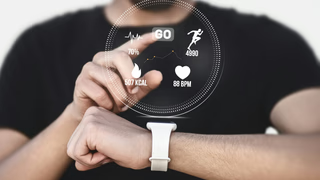
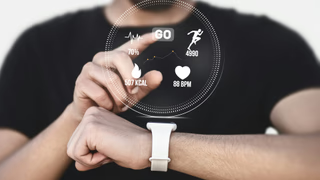
That said, researchers have expressed interest in extending 『SleepFM』‘s architecture to consumer-grade biosensor inputs. If future iterations can work with wearable data, even at reduced accuracy, the implications for population-scale screening become significant. A free or low-cost sleep app won’t replace a $3,000 lab study tomorrow, but the direction is clear.
For now, this research invites a gentle reconsideration: prioritizing sleep isn’t just about feeling rested. It may be one of the most information-rich things your body does.
Stanford’s 『SleepFM』 demonstrates that a single night of sleep holds predictive power over serious diseases years before symptoms emerge. It reframes sleep from a lifestyle metric into a diagnostic frontier, one that could reshape preventive medicine if access and equity challenges are addressed. Your body has been broadcasting its story every night. Science is finally learning to listen.